
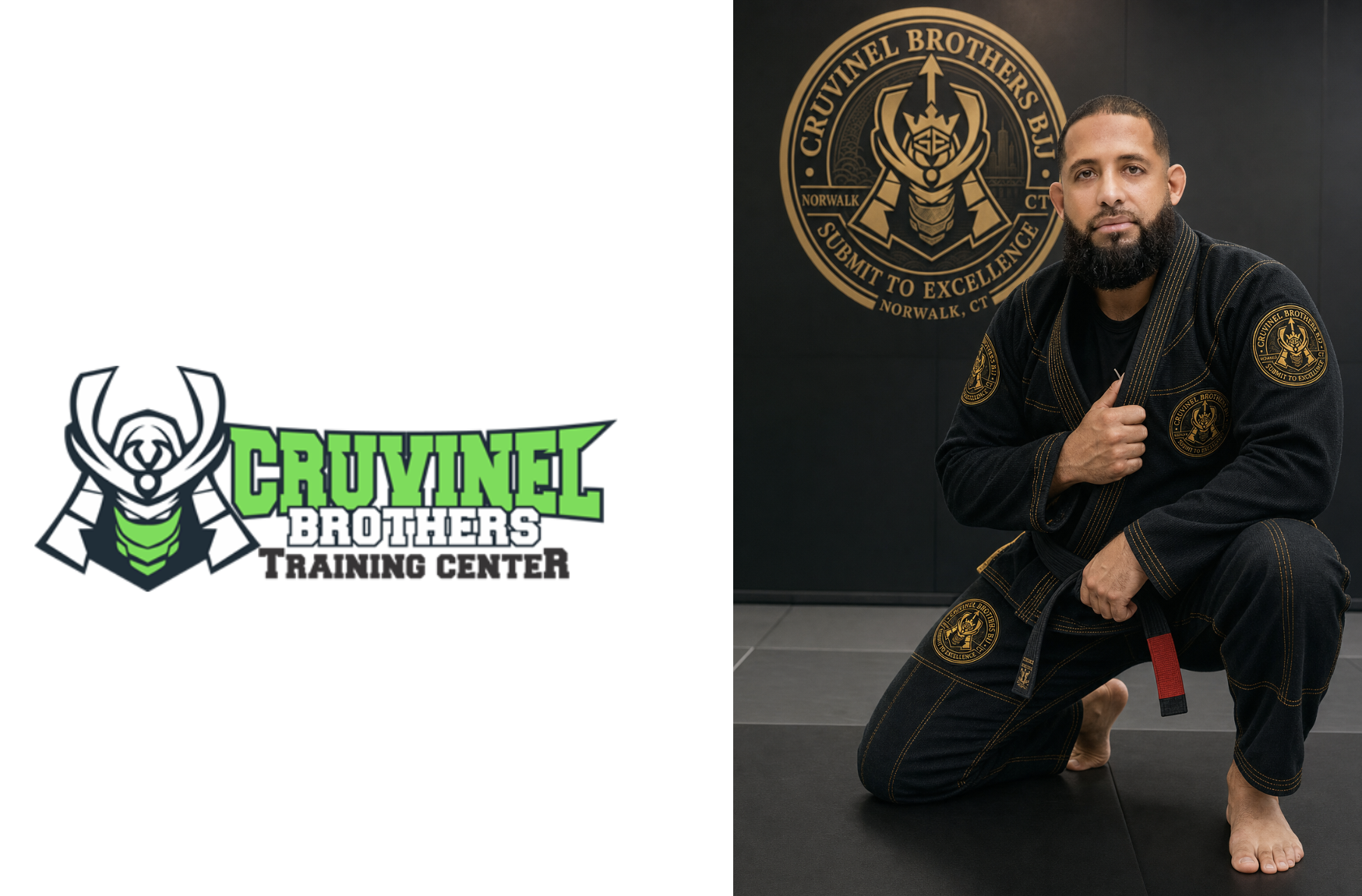
For twenty-five years I’ve taught people how to protect themselves, and in that time I’ve come to believe something that the martial arts world is finally starting to admit out loud: no single system has all the answers. That’s why I’m genuinely excited to share that starting October 21, Cruvinel Bros BJJ is joining us at our 295 Westport Avenue location, and why I think this is one of the best things to happen to our school in years. If you’ve trained Krav Maga with us, you already understand its logic — it’s built for the real world, for the sudden and ugly moments that don’t come with a warning. It teaches you to defend against a knife, a stick, a grab, a punch thrown in a parking lot, and to counterattack and get out. But here’s the honest truth that every seasoned instructor knows: a frightening number of real altercations end up on the ground, and if you’ve never trained there, the ground is a terrifying place to find yourself.
Now, the Krav Maga philosophy for the ground has always been simple and blunt: GTFU — get the fuck up. And that’s not wrong. The ground is the last place you want to be in a real fight, especially against multiple attackers or a weapon, and our instinct to get vertical and get out is exactly the right one. But here’s where I’ve had to be honest with myself and with you. The same way we drill footwork and movement when we’re standing — the way we obsess over angles, distance, and positioning on our feet — we have to develop that same fluency on the ground. You can’t GTFU if you don’t know how to move down there. If someone has you pinned, mounted, tangled up, and you’ve never trained the mechanics of escaping and controlling from the bottom, then “get up” is just a wish, not a plan. Movement on the ground is what makes GTFU actually possible. That’s the piece Krav has always pointed at but never fully taught, and it’s exactly the piece BJJ was built to deliver.
That’s why cross-training the two isn’t a gimmick — it’s completeness. Krav Maga owns the standing fight and the weapons threat; BJJ owns the ground. One teaches you to never be there if you can help it, to strike and escape and survive the chaos of a standing assault. The other teaches you what to do when, despite your best efforts, you end up on the pavement with someone on top of you — how to control them, how to not panic, how to create the space and leverage to get back to your feet. A student who trains both isn’t just adding techniques; they’re closing the biggest blind spot in their self-defense. They learn to flow from standing to ground and back, to read a confrontation wherever it goes, and to carry themselves with the quiet confidence that comes from knowing you’ve prepared for all of it, not just the parts that played to your strengths. I’ve watched Krav Maga practitioners become dramatically more dangerous — in the best sense — once they stopped fearing the ground, and I’ve watched BJJ athletes light up when they finally learned to defend a weapon and strike with intent. The two systems don’t compete. They complete each other.