

Watch a tai chi master move.
Nothing is rushed. Nothing is forced. The hand doesn’t arrive at a position. It flows there, and by the time you notice it has arrived, it’s already on its way somewhere else. The weight shifts before the step. The hip turns before the arm. Every movement is finishing one thing and starting the next at the same time.
That’s the beauty of it. And it’s easy to miss what’s actually happening, because we’ve been trained to look for power. Speed. Force. The big hit.
The tai chi master isn’t working toward power. He’s working toward connection. He’s connecting the dots.
What “connecting the dots” means
Every technique is made of pieces. A weight transfer. A rotation. An extension. A recovery. Most students learn these pieces one at a time, and then they try to bolt them together with effort. They muscle through the gaps.
The master doesn’t have gaps. The end of one movement *is* the beginning of the next. There is no reset, no pause to reload, no moment where the body is doing nothing. Momentum is never thrown away. It’s handed off.
That’s where the grace comes from. And that’s where the effectiveness comes from. They are the same thing.
Why this matters in Krav Maga
I know what some of you are thinking. Krav Maga isn’t tai chi. It’s fast, it’s aggressive, it’s built for the worst moment of your life.
All true. But fast and aggressive don’t come from trying to be fast and aggressive. They come from efficiency. A strike that has no wasted motion is a fast strike. A combination with no gaps between the pieces is an overwhelming combination. Not because you hit harder, but because the person on the other end never gets a window.
Power is a byproduct. Efficiency is the cause.
On the bag and on your partner
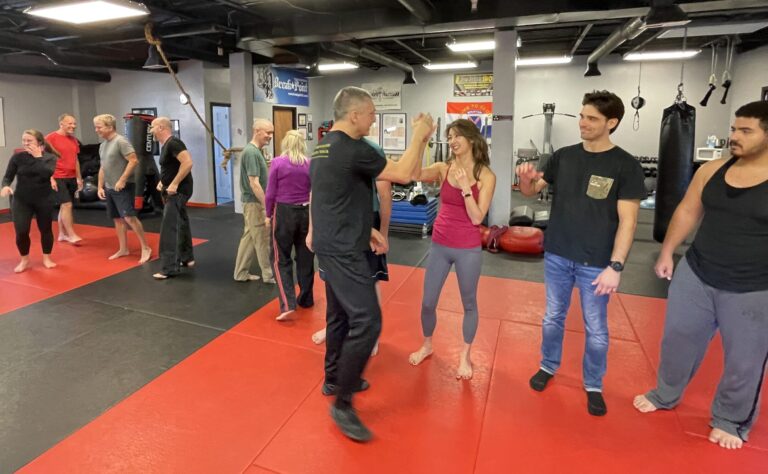
Here’s what I see on the mats. A student throws a combination on the bag. Punch. Stop. Punch. Stop. Knee. Stop. Each strike is decent on its own. Together they’re three separate events with dead air in between.
The dead air is where you lose the fight.
So when you’re working combinations on the bag, stop chasing the loud hit. Chase the connection. Ask yourself: where does the energy from this strike go? Does it die at the end of my arm, or does it feed the next movement? Does my recovery put me in position for the next strike, or do I have to reset first?
Same thing when you’re drilling techniques on a partner. The defense should flow into the counter. The counter should flow into the next counter, or the escape, or the control. If you’re stopping to think between pieces, you haven’t connected the dots yet. You’ve just memorized the dots.
Slow builds fast
The tai chi master moves slowly on purpose. Slow exposes the gaps. Slow lets you feel exactly where one movement fails to hand off to the next. You can’t hide bad mechanics at half speed.
My instructor, Alan Feldman, is the reason I became an instructor. He used to tell us to move as slowly as if we were moving through molasses. At the time I thought it was a warm-up. It took me years to understand it was the whole lesson. Molasses doesn’t let you cheat. Every inch has resistance, so every inch has to be deliberate. Nothing coasts. Nothing gets skipped.
In all my years of teaching, the three corrections I give most often are the same three words, over and over:
Breathe.
Hands up.
Slow down.
That’s it. Not “hit harder.” Not “faster.” Students want the big fix and the big fix is almost always the small one. Breathe, so your body isn’t fighting itself. Hands up, so your position never has to be rebuilt between strikes. Slow down, so you can actually feel where the dots aren’t connecting.
So slow down. Work the combination clean. Smooth out the transitions until there’s nothing left to smooth. Then add speed, and you’ll find the speed was already in there. You just uncovered it.
Smooth is clean. Clean is connected. Connected is effective.
That’s the habit we’re building. Not a bigger punch. A body that never stops being on its way to the next thing.
Connect the dots.